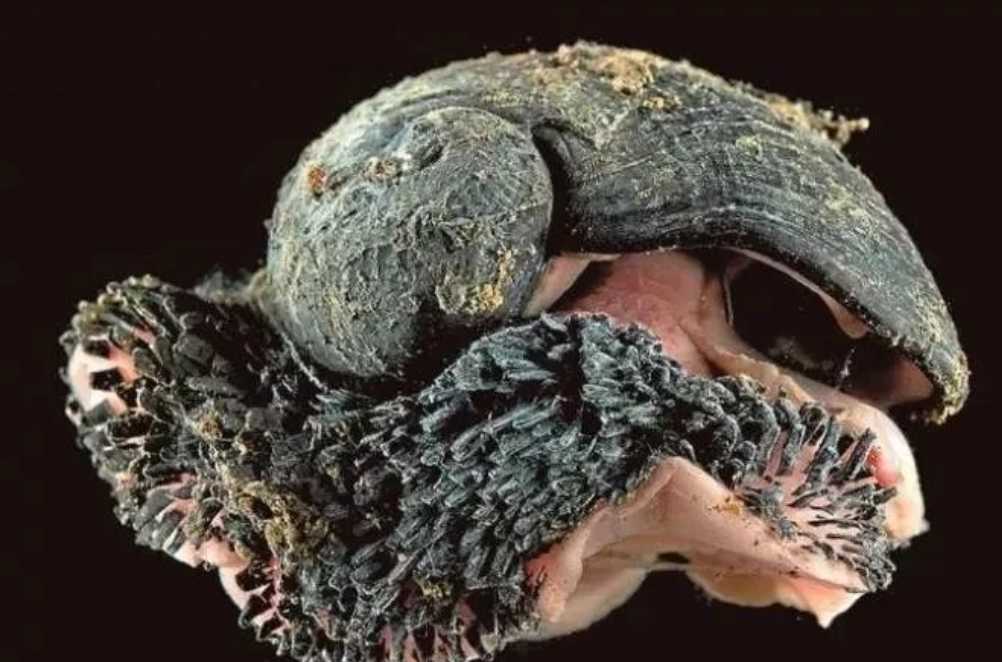
Living near hydrothermal vents in the Indian Ocean, the scaly-foot snail (Chrysomallon squamiferum) defies survival norms with its iron-clad armor and ability to withstand 350°C temperatures. This extraordinary gastropod, discovered in 2001 near the Kairei hydrothermal field, boasts a three-layered shell infused with iron sulfides, making it one of the few animals on Earth to incorporate metal into its exoskeleton. Its survival hinges on a tiny habitat—just two football fields in size—where it thrives in a world devoid of sunlight, relying on bacterial symbiosis for nutrition.
Anatomy of a Deep-Sea Warrior
The snail’s most remarkable feature is its composite shell:
Outer Layer: A thin, iron sulfide coating that forms sharp scales, deterring predators like crabs.
Middle Layer: A porous organic matrix that absorbs impact, similar to Kevlar.
Inner Layer: A calcium carbonate shell for structural support.
This armor isn’t just defensive; it’s a product of its extreme environment. Seawater superheated by vents dissolves minerals, which the snail’s tissues convert into iron sulfides. Even its foot is armored, with iron-rich scales protecting it from scalding fluids.
Nutritionally, the snail is a biological oddity. Instead of eating, it harbors γ-Proteobacteria in its gills, which convert hydrogen sulfide from vents into energy via chemosynthesis. This symbiosis eliminates the need for traditional feeding, allowing it to thrive in an ecosystem where organic matter is scarce.
Vulnerability in a Fragile Paradise
Restricted to only a few Indian Ocean vent fields, the scaly-foot snail faces existential threats. Deep-sea mining for rare minerals has already destroyed parts of its habitat, and exploratory drills risk disrupting the delicate chemistry of hydrothermal vents. Unlike most snails, it has a low reproductive rate, laying fewer than 100 eggs annually, which compounds its vulnerability to population loss.
In 2019, the IUCN classified it as "Endangered," highlighting the urgency of protecting its tiny range. Scientists argue that vent ecosystems like these hold keys to understanding life’s origins and potential extraterrestrial habitats. For the scaly-foot snail, survival isn’t just about its own future—it’s a battle to preserve one of Earth’s last frontiers of biological innovation.
In the pitch-black depths where no sunlight reaches, this armored mollusk stands as a testament to nature’s ability to craft life in the most inhospitable places. Its existence reminds humanity that even in the ocean’s darkest corners, marvels of evolution await—if we choose to protect them